My research sits where optimization and machine learning meet, and it runs in both directions. I design machine learning for optimization: learned control laws and surrogates built around the structure of the optimization problem they serve. And I use optimization for machine learning: algorithms that train interpretable models, such as clustering and decision trees, to global or near-global optimality at scale. The applications are in process, energy, and manufacturing systems.
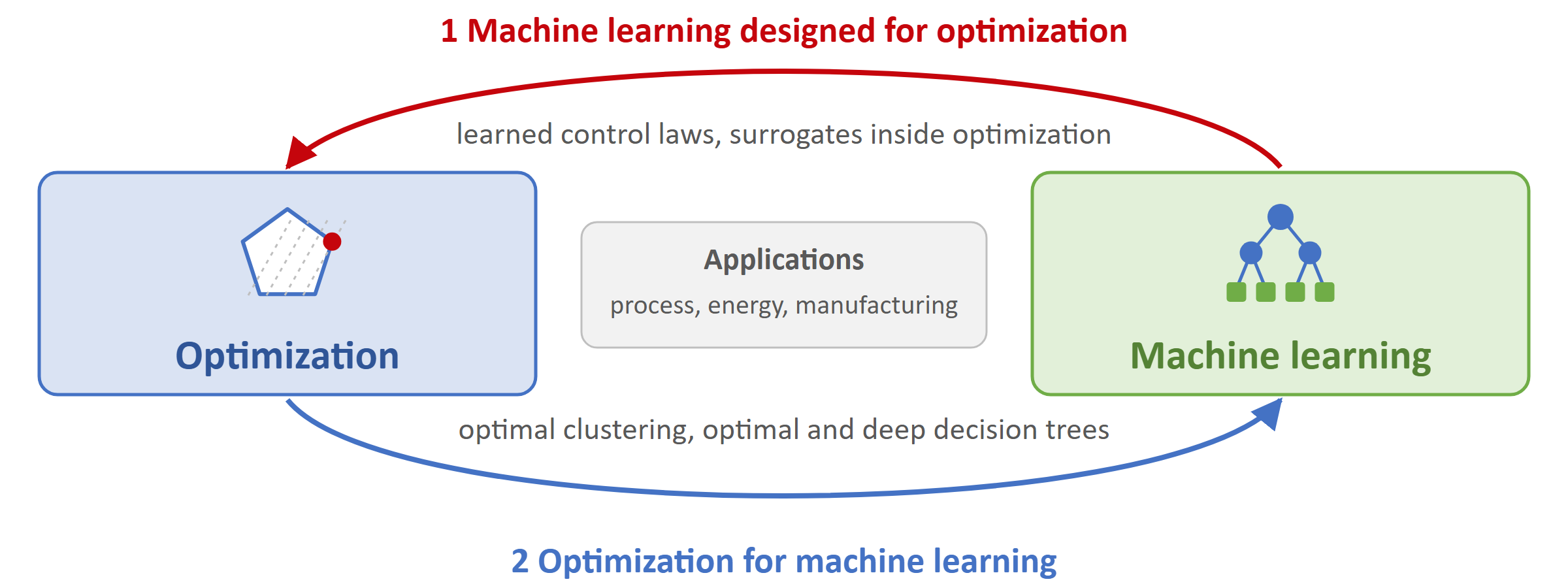
Machine Learning Designed for Optimization
Many decisions require solving an optimization problem over and over, or contain a part that is too expensive to solve exactly. I replace these parts with learned models designed specifically for the optimization problem.
Learned Control Laws
 Enlarge
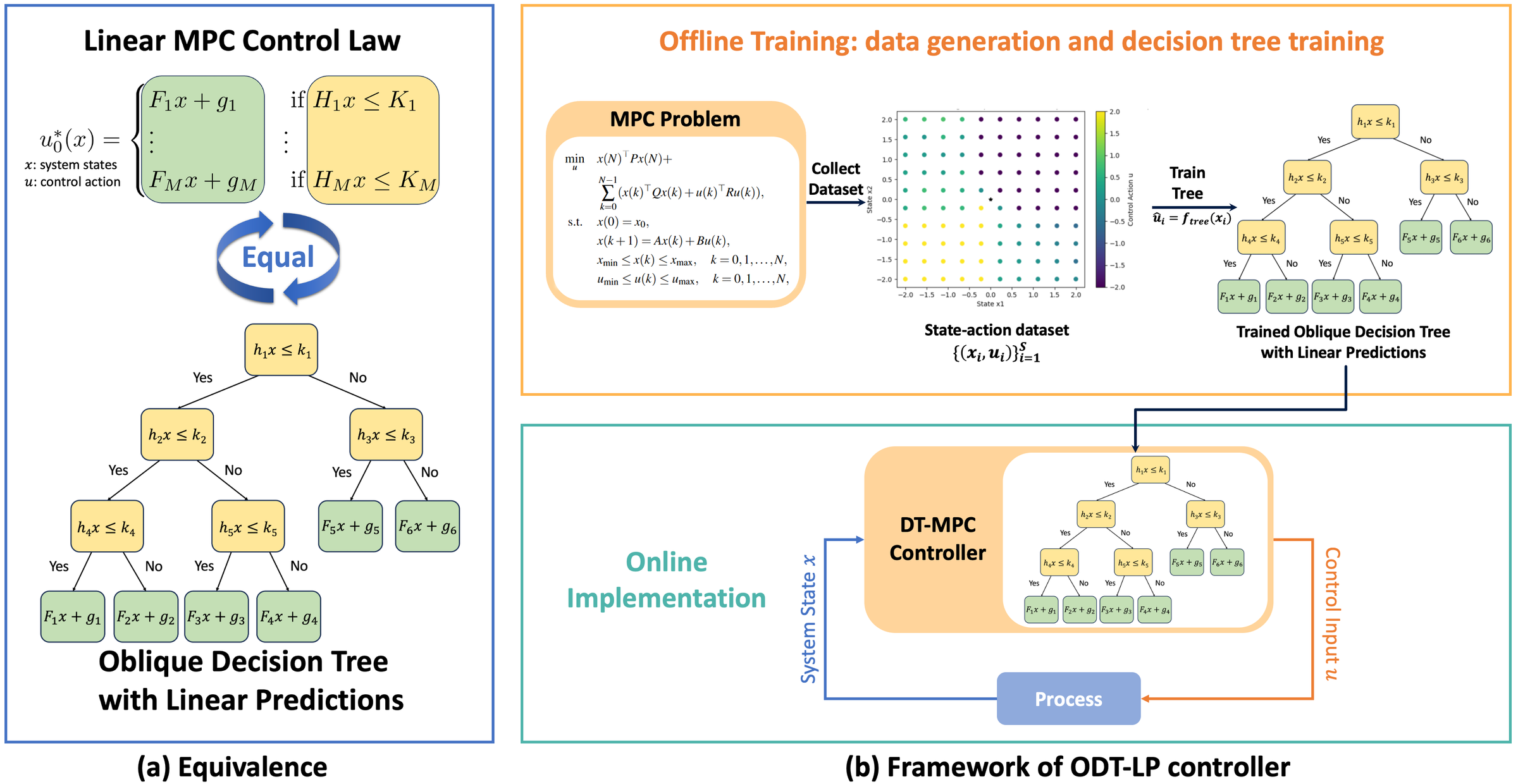
Model predictive control (MPC) performs well but must solve an optimization problem online at every step. The control law of linear MPC is piecewise affine, so it can be represented exactly by an oblique decision tree with linear predictions at the leaf nodes. The structure of the optimization problem decides the model: I learn MPC laws as interpretable decision trees offline and deploy the tree online as the controller.
The resulting controllers perform competitively with MPC at the speed of a low-level PID controller: over 1,000× faster than MPC and 10× faster than neural network equivalents. I have extended this framework to quadcopter control and to interpretable reinforcement learning for multi-loop adaptive PID control.
IEEE CDC (2025) · IFAC World Congress (2026) · IEEE T-ASE (2024) · Energy (2025)
Current Work: Surrogates Inside Optimization
 Enlarge
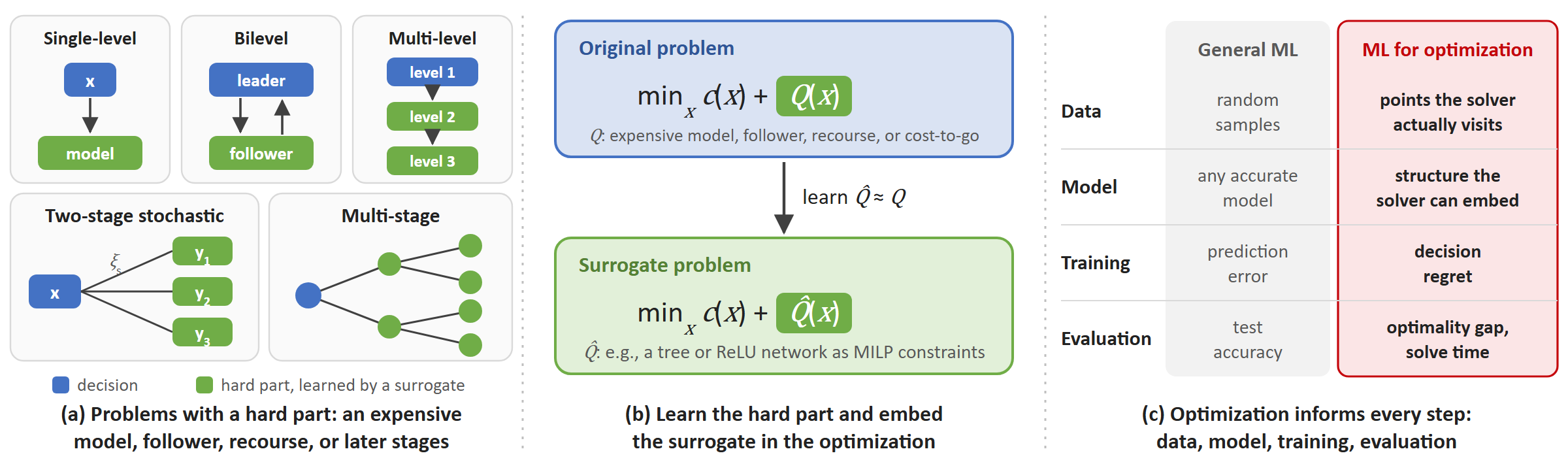
At UW–Madison, I am extending this idea to decision-focused and surrogate-based optimization: designing surrogates specifically for optimization by bringing information from the optimization problem into every step of learning. These surrogates replace the hard parts of a problem, such as expensive models in single-level problems, the follower in bilevel and multi-level problems, the recourse in two-stage stochastic programs, and the later stages of multi-stage problems, with applications in process and energy systems.
Optimization for Interpretable Machine Learning
Interpretable models such as clustering and decision trees are easy to read and verify, but training them well is a hard combinatorial optimization problem, so in practice they are often trained with heuristics. I develop optimization algorithms that train them to global or near-global optimality at scale.
Global Optimal Clustering
 Enlarge
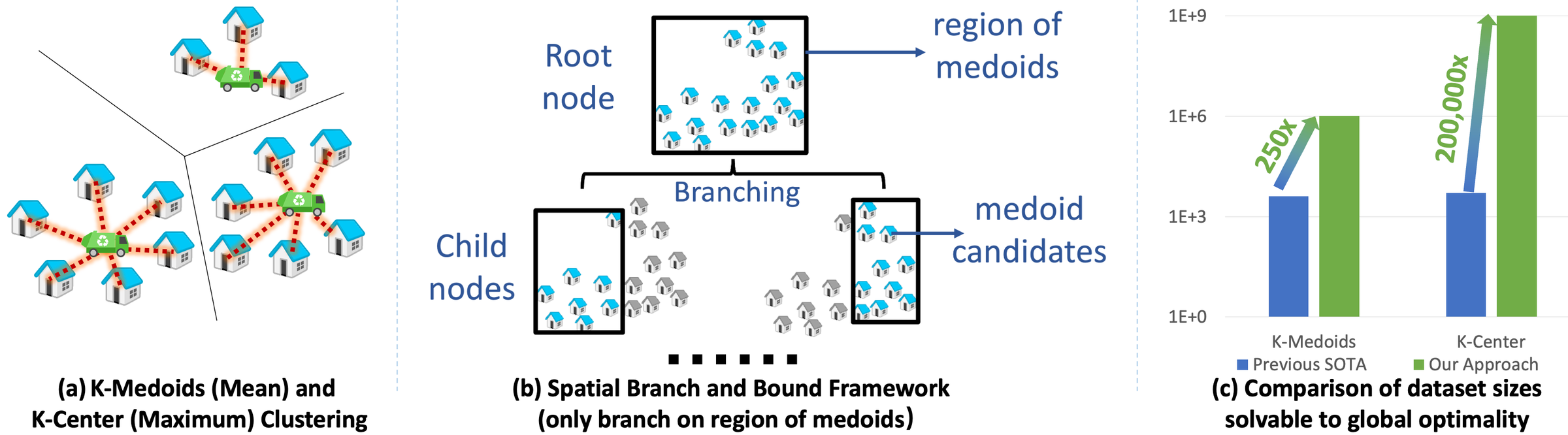
I developed reduced-space spatial branch-and-bound algorithms for K-Medoids and K-Center clustering, with customized lower bounds, bound tightening, and sample reduction, accelerated on hybrid CPU–GPU hardware. They solve problems with up to one billion samples to global optimality, scaling 250× (K-Medoids) and 200,000× (K-Center) beyond earlier exact methods, with over 20% better objectives than widely used heuristics.
Management Science (2026) · NeurIPS (2022) · ICML (2022)
Optimal and Deep Decision Trees
 Enlarge
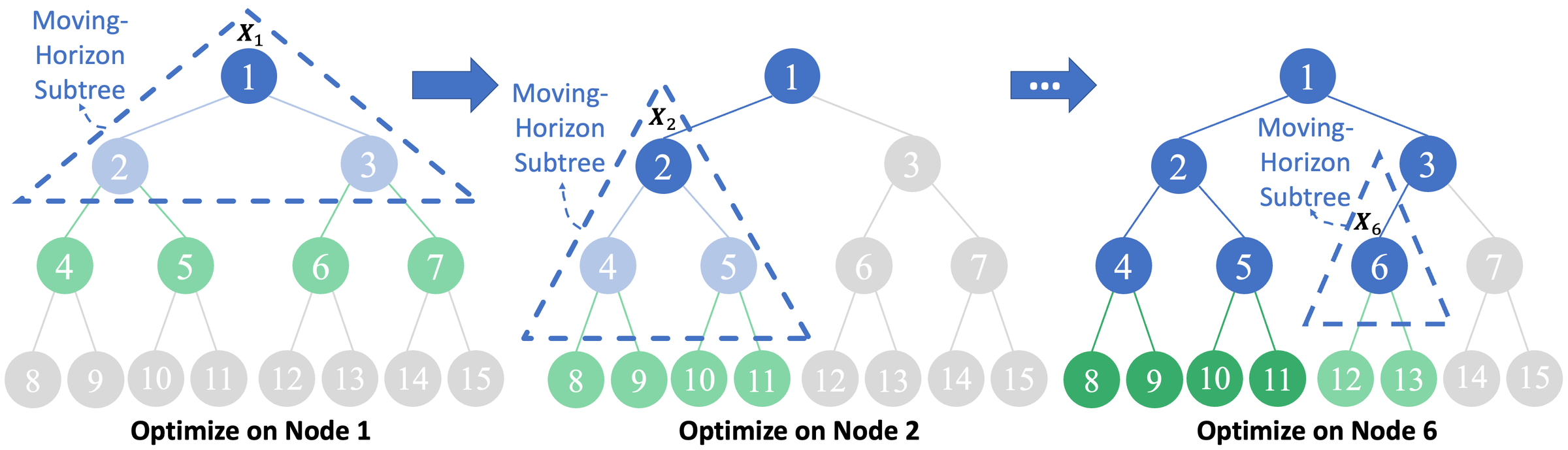
I work on algorithms that train decision trees close to optimality: a scalable deterministic global optimization algorithm for optimal decision trees, GPU-accelerated moving-horizon methods that train deep classification trees on up to ten million samples, and a differentiable “ReLU+Argmin” reformulation of decision trees for gradient-based training. The code is available as MHDETrees.jl.
TMLR (2026, J2C) · ESWA (2026) · NeurIPS (2025, Spotlight) · NeurIPS (2022, Best Theoretical Paper at the INFORMS Data Mining Workshop)
Applications
These methods are applied to process, energy, and manufacturing systems, including industrial paddy drying (Energy, 2025), battery management for frequency regulation (I&EC Research, 2022), capacity estimation of lithium-ion batteries (ADCHEM, 2024), biorefining (ESCAPE, 2023), and quadcopter control (IFAC World Congress, 2026).
Earlier Work: Data-Driven Process Monitoring
 Enlarge
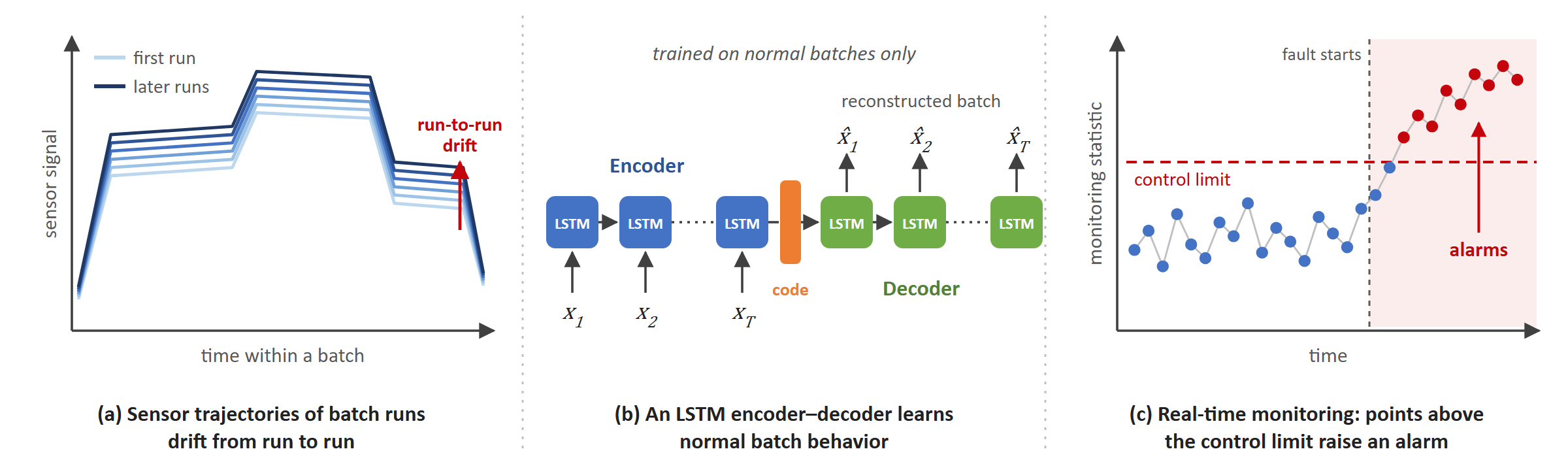
During my Master’s at Zhejiang University, I developed real-time fault detection methods for semiconductor batch processes, including a SARIMA-based drift compensation framework and an LSTM encoder–decoder network for batch process monitoring.
IEEE TSM (2021) · CHERD (2020)